


Introduction
Global financial crime compliance costs have reached a staggering $274 billion annually (Flagright), yet the systems institutions rely on remain alarmingly inefficient. An estimated 90-95% of all alerts generated by transaction monitoring systems are false positives (PricewaterhouseCoopers), burying compliance teams in unproductive work while genuine threats slip through the cracks.
The traditional approach — rule-based systems generating massive alert volumes for human analysts to manually review — is reaching its breaking point. Personnel costs dominate at 79% of total compliance spending, while technology investment accounts for just 9% (Fourthline). The imbalance is clear: institutions are throwing bodies at problems that demand intelligence.
Enter agentic AI — autonomous AI agents that execute AML tasks with human oversight at critical decision points. This “agent-in-the-loop” paradigm represents a fundamental shift from reactive, rules-driven compliance to adaptive, intelligent workflows. In this article, you will learn how this new operating model works, where it applies across AML processes, what governance frameworks it requires, and how to build a practical implementation roadmap.
The Breaking Point of Traditional AML Systems

Traditional AML systems were designed for a simpler era of financial crime. Today, they generate overwhelming alert volumes while catching only a fraction of illicit activity. According to Interpol, the financial industry detects only about 2% of global financial crime flows (McKinsey), despite spending increases of up to 10% per year in advanced markets between 2015 and 2022.
The numbers paint a stark picture:
Fintechs and banks collectively spend $206 billion per year on financial crime compliance, with North America alone accounting for $61 billion (Fourthline, 2024 survey). A remarkable 98% of institutions reported that compliance costs increased year-over-year in 2023.
The productivity gap is equally concerning. Mid-size banks generate approximately 3,908 alerts per month from 9.6 million monitored transactions, resulting in only 108 SARs filed — a conversion rate of just 2.8% (2018 MBCA Survey). Large institutions took an average of 166 days to file SARs on suspicious transactions (FinCEN files, 2011-2017). And in 2024, regulators imposed $4.5 billion globally in fines for financial crime protocol breaches (Fintech Global).
The cost of inaction compounds rapidly. For every $1 lost to fraud, institutions spend an additional $4.04 to address it — up from $3.85 in 2023 (Fourthline). Non-compliance costs average $15 million per firm, which is 2.71x higher than the cost of staying compliant (Ascent RegTech).
What “Agent in the Loop” Means for AML
The “agent-in-the-loop” model sits between two extremes that both carry significant risk:
Fully Automated
-
- No human judgment
-
- High regulatory risk
-
- Cannot explain decisions
-
- Brittle to novel typologies
Agent-in-the-Loop (Optimal)
-
- AI handles volume and pattern detection
-
- Humans validate high-risk decisions
-
- Explainable, auditable outputs
-
- Adaptive to new threats
Fully Manual
-
- Extremely slow and expensive
-
- Analyst fatigue and inconsistency
-
- Cannot scale with transaction volume
-
- Reactive, not proactive
In the agent-in-the-loop model, autonomous AI agents execute the bulk of AML operational tasks — data gathering, pattern recognition, alert triage, evidence compilation, and draft output generation. Human compliance professionals retain oversight at critical decision points: validating escalations, approving SAR submissions, overriding edge cases, and providing feedback that continuously improves agent performance.
McKinsey recommends that manual intervention should be reserved for only the highest-complexity exceptions and escalations — typically less than 15-20% of total case volume — with human experts focusing on validation and coaching the AI agent workforce (McKinsey).
The results speak for themselves. A tier-1 bank in Singapore using ML-powered solutions achieved a 70% reduction in false positives for individual name screening and a 50% reduction in transaction monitoring false positives, while simultaneously achieving a 5% increase in true positives (Tookitaki). Nasdaq Verafin’s agentic AI workforce, launched in July 2025, reduced sanction-screening alerts by more than 80%, freeing human investigators to focus on high-value cases (Nasdaq Verafin).
Key Application Areas for AI Agents in AML

Agentic AI transforms AML compliance across five critical domains. Each area leverages specialized agents working in orchestration, with human oversight gates at regulatory decision points.
Transaction Monitoring
AI agents dynamically adjust detection thresholds based on customer context, geography, and behavioral patterns. Unlike static rules, agents perform multi-step reasoning across accounts, entities, and time periods. They identify complex layering schemes and behavioral anomalies that rule-based systems miss entirely.
The industry benchmark for a healthy false positive rate is approximately 15% (Sanctions Scanner), compared to the current average of 90-95%. The gap represents the opportunity for agent-based systems. The transaction monitoring market itself is projected to grow from $14.7 billion in 2022 to $39.5 billion by 2032 (DataRobot), driven largely by AI adoption.
Alert Triage and Investigation
Agentic AI clears false positives the way an experienced analyst would — reviewing alert context, checking against known patterns, and escalating only genuine risks. AI agents consolidate information from multiple data sources, classify risks by typology, and generate investigation narratives.
This reduces alert backlogs without adding headcount. The agent workforce handles scale while human investigators focus on complex, high-judgment cases.
SAR Drafting and Reporting
Agents auto-draft Suspicious Activity Reports with supporting evidence packages assembled from transaction data, customer profiles, and historical activity. Human reviewers approve, edit, and submit — refining rather than creating from scratch.
Context matters: mid-size banks produce only 108 SARs from nearly 4,000 monthly alerts — a 2.8% conversion rate (MBCA Survey). Agents pre-filter noise so analysts spend time on the SARs that matter.
Customer Due Diligence (CDD/EDD)
AI agents gather and synthesize data from sanctions lists, adverse media, corporate registries, and beneficial ownership databases. They produce risk rating proposals with explainable justifications, flagging discrepancies for human review.
Enhanced Due Diligence reviews — traditionally among the most labor-intensive compliance tasks — benefit enormously from agent automation of upstream data gathering and pattern matching.
Model Tuning and Analytics
Agents continuously retrain risk scoring models on emerging typologies, create challenger models, and run backtests — all without analyst intervention. Human approval gates remain before any model enters production. Real-time dashboards generated by analytics agents identify anomalies in KPIs such as alert volumes, investigation timelines, and escalation rates.
Banks using smart AML software have reported up to 60% reduction in compliance costs (Tookitaki). The ROI case for agentic AI in AML is no longer theoretical.
Architecture of an Agent-Based AML System
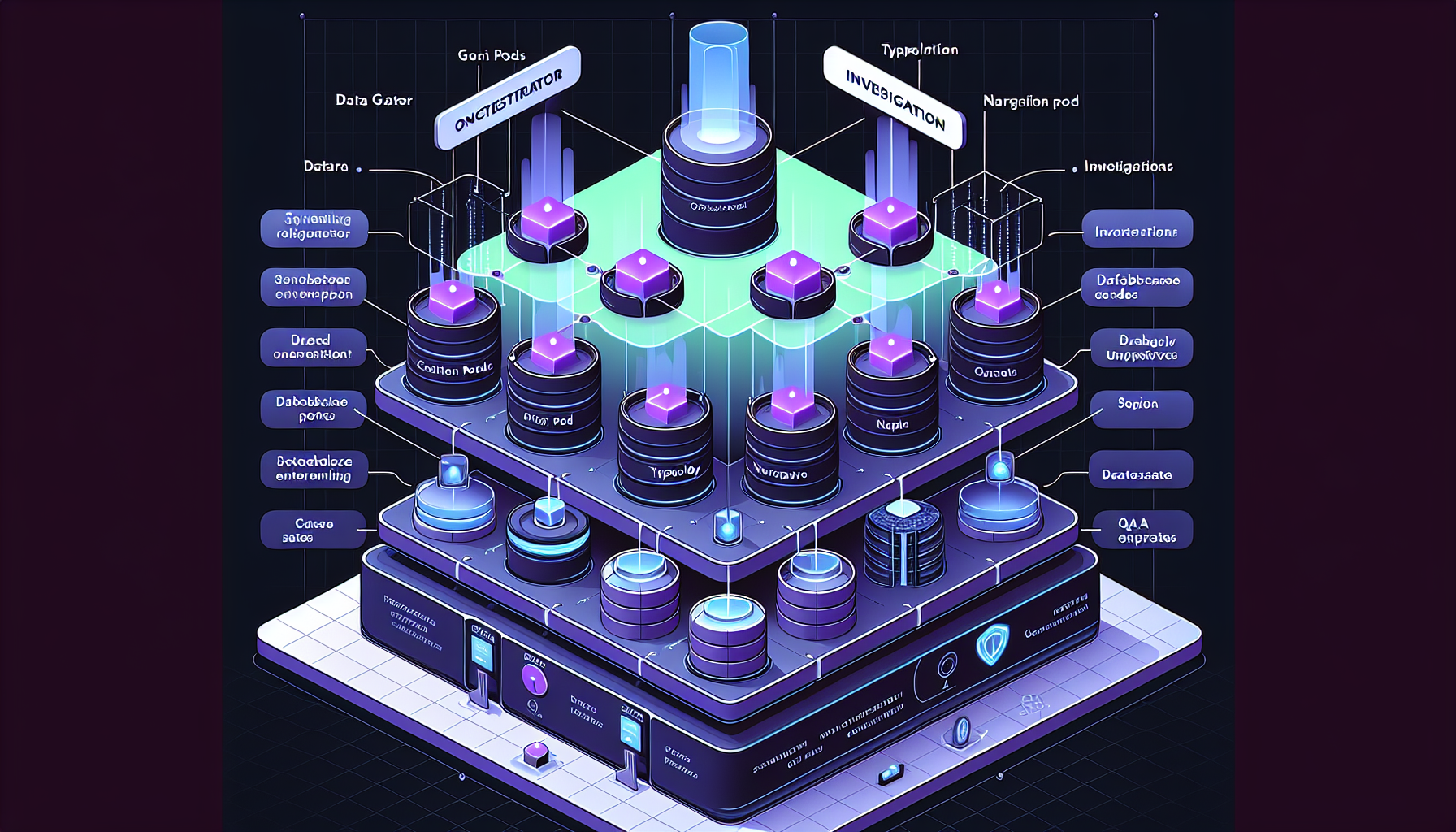
Building an effective agentic AML system requires thoughtful architecture across five layers:
Orchestration Layer
The orchestration layer coordinates multiple specialized agents across AML sub-processes. A typical multi-agent setup includes:
- Data-gathering agents that consolidate information from internal databases, external APIs, and document stores
- Typology agents that classify risks against known and emerging patterns
- Investigation agents that compile evidence and trace transaction flows
- Narrative agents that draft SARs and investigation reports
- QA agents that verify each agent has completed its tasks to required standards
McKinsey recommends including a QA agent in each agent squad, with future implementations potentially adding dedicated compliance agents and audit agents (McKinsey).
Memory and Context
Agents must maintain investigation history across sessions. A customer flagged in January may show related suspicious activity in June — the system needs persistent memory to connect these events. Retrieval-Augmented Generation (RAG) anchors AI insights in real-time data, preventing hallucinated evidence while maintaining contextual awareness.
Guardrails and Explainability
Regulators require reasoning transparency for all AML decisions. The EU AI Act has embedded explainability into law, and jurisdictions from Singapore to Saudi Arabia have introduced AI governance principles with clear oversight expectations.
Every agent action must produce an auditable trail. Guardrails prevent hallucinated evidence, ensure regulatory alignment, and enforce escalation protocols when agent confidence drops below defined thresholds. Maker-Checker validation ensures AI-generated conclusions are cross-verified and subject to human oversight.
Tool Integration
Agents interact with:
- Internal transaction databases and customer information systems
- External sanctions lists and PEP databases
- Adverse media screening APIs
- Corporate registry and beneficial ownership services
- Case management systems for workflow integration
Tiered Autonomy
Not all decisions carry equal risk. The system implements graduated autonomy:
Full Automation (Low Risk)
Routine alert triage, data enrichment, obvious false positive clearance — agents handle end-to-end.
Agent Draft + Human Review (Medium Risk)
SAR narratives, EDD assessments, model recommendations — agents prepare, humans validate.
Human Decision Required (High Risk)
Account closures, law enforcement referrals, complex escalations — human judgment is mandatory.
Governance, Risk, and Regulatory Challenges
Deploying AI agents in AML compliance introduces governance challenges that institutions must address proactively.
Model Risk Management
Financial regulators expect rigorous model governance under frameworks like SR 11-7 (U.S.) and SS1/23 (UK). AI agents must be subject to independent validation, ongoing monitoring, and periodic re-approval. Each agent’s decision logic — even when powered by large language models — must be documented, tested, and auditable.
Data Privacy and Residency
AML agents process sensitive personal and financial data subject to GDPR, local data residency laws, and sector-specific regulations. Architecture decisions around data flow, storage, and cross-border processing require early legal and compliance input.
Regulatory Uncertainty
AML regulations have traditionally been technology-neutral, creating ambiguity around AI validation, audit, and governance. While regulators like the OCC and FinCEN are encouraging AI-driven solutions (PYMNTS), actionable guidance on AI-specific requirements remains evolving.
Bias and Fairness
Risk scoring models can inadvertently encode demographic bias. Institutions must implement fairness testing across customer segments, with regular audits ensuring AI agents do not disproportionately flag or de-risk specific populations.
The Dual-Use Threat
Criminals are also leveraging AI — creating synthetic identities, deepfakes, and forged documents that bypass traditional KYC checks (Sumsub). The scale of illicit finance remains enormous, estimated at $2.17 to $3.61 trillion annually (approximately 3-5% of global GDP) according to the UN. Agentic AI on the compliance side must evolve continuously to stay ahead of adversarial AI applications.
Metrics to Track Agent Effectiveness
Deploying AI agents without measurement is flying blind. Track these KPIs to calibrate agent performance:
| Metric | Baseline (Traditional) | Target (Agent-Enabled) |
|---|---|---|
| False Positive Rate | 90-95% | <15% |
| SAR Filing Time | 166 days | <30 days |
| Alert-to-SAR Conversion | 1-5% | 15-25% |
| Compliance Cost Reduction | Baseline | Up to 60% |
| Human Override Rate | N/A | <20% (calibration signal) |
| True Positive Improvement | Baseline | +5% or more |
The human override frequency serves as a critical calibration signal. If humans override agent decisions too frequently, the agent requires retraining. If overrides approach zero, the system may lack sufficient human scrutiny. A healthy equilibrium indicates the agent is handling routine work accurately while surfacing genuinely difficult cases for human judgment.
Implementation Roadmap

Transitioning from traditional AML to an agent-in-the-loop model requires a phased approach. Each phase builds capabilities and institutional confidence before expanding agent autonomy.
Phase 1: Alert Triage
Deploy agents for low-risk, high-volume alert triage. Humans review all escalations. Establish baseline metrics and build trust.
Phase 2: Evidence & SAR Drafting
Agents gather evidence and draft SARs. Human analysts review and refine before submission. Measure quality and turnaround gains.
Phase 3: Dynamic Model Tuning
Agents retrain models and create challengers. Human approval gates before production. Expand typology coverage continuously.
Phase 4: Cross-Process Orchestration
Full integration across CDD, TM, and reporting. Multi-agent squads with QA agents. Humans focus on edge cases and strategy.
Phase 1: Agent-Assisted Alert Triage
Start with the highest-volume, lowest-risk process. Deploy agents to review and classify alerts, clearing obvious false positives and escalating genuine risks. Human analysts review all escalated cases and provide feedback that tunes agent accuracy. This phase establishes trust, proves ROI, and creates training data for subsequent phases.
Phase 2: Automated Evidence Gathering and SAR Drafting
Once alert triage agents demonstrate consistent accuracy, expand to investigation support. Agents compile evidence packages — transaction histories, customer profiles, entity relationships — and draft SAR narratives. Human investigators review, refine, and submit. This phase targets the 166-day SAR filing bottleneck directly.
Phase 3: Dynamic Model Tuning
With confidence in agent quality established, allow agents to propose model adjustments. Agents identify emerging typologies from the cases they process, create challenger models, and backtest against historical data. Human model risk teams approve or reject before production deployment.
Phase 4: Cross-Process Orchestration
The final phase integrates agent capabilities across the full AML lifecycle — from customer onboarding (CDD/EDD) through ongoing transaction monitoring to reporting. Multi-agent squads coordinate end-to-end, with specialized QA agents ensuring quality at every step. Human experts focus on the 15-20% of cases requiring genuine judgment, strategic decisions, and regulatory relationship management.
The Road Ahead
The agent-in-the-loop model is not a distant future — it is arriving now. According to the UK’s Financial Conduct Authority, 75% of firms are already using AI, with another 10% planning adoption within three years (Moodys). Industry adoption of AI/ML for AML is expected to reach 90% by 2025. Major players including McKinsey/QuantumBlack, Oracle Financial Services, Nasdaq Verafin, and specialized RegTechs like Lucinity and Hawk are shipping production-grade agentic solutions.
The regulatory landscape is catching up. The EU AI Act mandates explainability. Singapore and Hong Kong have introduced AI governance principles. FinCEN and the OCC are actively encouraging innovation while establishing guardrails. The institutions that move first — building the governance frameworks, proving the ROI, and developing the human-agent collaboration muscle — will define the standard for the industry.
The Bottom Line
AI agents don’t replace compliance professionals — they amplify them. The agent-in-the-loop model transforms AML teams from alert-processing factories into strategic risk management units.
The question is no longer whether to adopt agentic AI for AML, but how fast you can build the governance framework to deploy it responsibly.
Conclusion
The traditional AML operating model — built on rigid rules, overwhelming alert volumes, and manual analyst labor — cannot keep pace with modern financial crime. With detection rates at 2%, false positive rates above 90%, and compliance costs exceeding $200 billion annually, the case for transformation is undeniable.
AI agents in the loop offer a practical path forward. By automating high-volume, pattern-driven tasks while preserving human oversight for high-stakes decisions, institutions can dramatically reduce false positives, accelerate SAR filing, cut compliance costs by up to 60%, and — critically — catch more actual financial crime.
The implementation roadmap is clear: start with alert triage, expand to investigation support, enable dynamic model tuning, and build toward full cross-process orchestration. At each phase, human expertise remains central — not for processing volume, but for exercising judgment, ensuring governance, and coaching the agent workforce.
The institutions that embrace this model now will not only reduce costs and regulatory risk — they will build a compliance function that genuinely disrupts financial crime, rather than merely processing alerts about it.
—
Sources referenced in this article include data from Flagright, Fourthline, McKinsey, PricewaterhouseCoopers, Tookitaki, Nasdaq Verafin, Sanctions Scanner, Fintech Global, Ascent RegTech, Unit21, DataRobot, and Sumsub.