
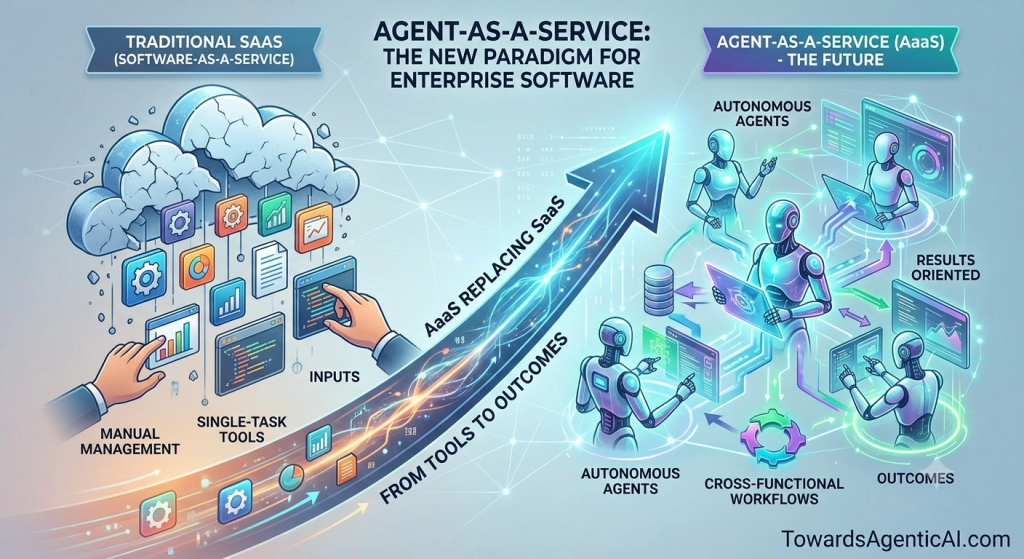
The software industry’s foundational business model—the subscription seat—is under the most serious structural threat it has ever faced. At GTC 2026, NVIDIA CEO Jensen Huang made a declaration that reverberated through boardrooms and venture capital offices alike: “Every SaaS company will become an AaaS company.”
That three letter acronym AaaS, or Agent-as-a-Service is now the centre of gravity for enterprise technology strategy. By mid-2026, $4.2 billion in venture capital flowed into AI agent startups in a single quarter. Gartner projects that 40% of enterprise software will incorporate intelligent agent capabilities within the year. And Bloomberg estimates that outcome-based pricing models will leap from 10% to 60% of software contracts over the next decade, as subscription licensing falls from 60% to 30%.
This is not incremental change. This is a restructuring of how value is created, priced, and delivered by software. In this article, we break down what Agent-as-a-Service actually means, how it works, which platforms are leading the charge, and what it signals for the future of enterprise AI.
What Is Agent-as-a-Service (AaaS)?
Agent-as-a-Service is a software delivery model in which AI agents autonomous systems capable of planning, reasoning, using tools, and taking actions are offered as managed, on-demand services. Rather than licensing a tool and expecting humans to operate it, AaaS delivers the outcome of that tool being operated intelligently and continuously.
Think of it as the difference between buying a car and hiring a professional driver. SaaS gave organisations the car the CRM, the helpdesk, the analytics dashboard. AaaS provides the driver: an autonomous agent that logs into those systems, reads the data, makes decisions, and takes action—without waiting for a human to click a button.
The defining characteristics of AaaS are:
This is what separates AaaS from earlier AI-as-a-Service models. Prior AI services delivered predictions—a sentiment score, an image classification, a recommendation. AaaS delivers action.
The Seismic Shift: From SaaS to AaaS
To understand why AaaS is so disruptive, it helps to understand what it replaces and what it preserves.
The SaaS model, perfected over the last two decades, is fundamentally a licence to access a tool. The tool provides capability; the human provides the cognition. SaaS vendors competed on features, UX, integrations, and uptime. They measured success in monthly active users, seat count, and net revenue retention.
AaaS inverts that relationship entirely. The agent provides both the capability and the cognition. Humans set objectives and review outcomes. The vendor is no longer selling access to a tool—they are selling the work itself.
This shift is not theoretical. The “SaaSpocalypse” of early 2026 wiped approximately $285 billion from software stock valuations as investors began pricing in the disruption risk. Enterprise procurement desks are running RFPs for agent platforms. The Fortune 500 is asking “how fast can we roll this out?”—not “should we adopt AI agents?”
The AaaS Architecture: What Powers It
Understanding AaaS requires understanding the technical stack beneath it. These systems are more complex than simple chatbots—they are layered architectures that combine foundation models, orchestration engines, memory systems, and governance rails.
Each layer plays a critical role:
Foundation Models are the reasoning engine. They interpret goals, plan steps, evaluate tool outputs, and generate responses. In 2026, the leading AaaS platforms draw on proprietary fine-tuned models or frontier models from OpenAI, Anthropic, and Google.
Memory & Context is what separates capable agents from sophisticated autocomplete. Long-term memory allows agents to recall past customer interactions, track ongoing workflows, and build institutional knowledge over time.
Tool & Integration is where the agent actually does work. An agent without tool access is just a chatbot. Tool access transforms agents into workers—they can query databases, send emails, update CRM records, trigger workflows, and even write and execute code.
Orchestration manages the cognitive work of complex, multi-step tasks—breaking a high-level goal into subtasks, routing subtasks to specialised agents, managing retries, and synthesising results.
Governance is the layer that enterprise procurement actually cares about. Only 21% of organisations currently have a mature governance model for autonomous AI agents, making this the primary adoption bottleneck in 2026.
The Platforms Leading the AaaS Wave
Every major enterprise software vendor has either launched or is actively building an agent layer. Here are the platforms that have moved from roadmap to production.
Salesforce Agentforce
Launched at Dreamforce 2024, Agentforce is Salesforce’s flagship AaaS offering and one of the fastest-growing enterprise products in the company’s history. It reached $800M ARR by mid-2026, with over 29,000 signed deals. Agentforce agents operate natively within Salesforce’s Data Cloud, handling sales outreach, lead qualification, service case resolution, and marketing campaign execution.
The pricing model is telling: rather than additional seats, Salesforce charges per conversation—a direct expression of the AaaS philosophy that value should be tied to work performed, not access granted.
Microsoft Copilot Studio
Microsoft’s Copilot Studio has become the highest-volume agentic platform of 2026, with over 160,000 organisations deploying more than 400,000 custom agents. Built on top of the Power Platform with deep Microsoft 365 integration, Copilot Studio offers a low-code environment for organisations to build agents that work across Teams, Outlook, SharePoint, and third-party systems.
Microsoft’s moat here is distribution agents built in Copilot Studio slot into the workflows employees already use, dramatically lowering the adoption barrier.
ServiceNow AI Agents
ServiceNow earned the top ranking in Gartner’s 2025 Critical Capabilities report for Building and Managing AI Agents. Its AI Agent Orchestrator coordinates multiple specialised agents across ITSM, HR, and customer service workflows. The AI Control Tower provides a unified governance console for monitoring agent behaviour in production—addressing the governance gap that remains the most cited enterprise concern.
Amazon Bedrock AgentCore
AWS’s answer to AaaS is Amazon Bedrock AgentCore—a managed runtime for building, deploying, and operating agents at enterprise scale. AgentCore provides the infrastructure scaffolding (memory, tool execution, session management) so teams can focus on agent logic rather than plumbing. Its deep integration with the AWS ecosystem makes it the natural choice for organisations already running workloads on AWS.
Business Use Cases Already Delivering ROI
The AaaS conversation is no longer theoretical. Across sectors, organisations are reporting measurable returns from production agent deployments.
The common thread across these use cases is scale. An agent can handle 10,000 customer queries simultaneously with the same quality as the first. It does not have sick days, onboarding periods, or context-switching penalties. The economics are simply different from human labour.
The Pricing Revolution: From Seats to Outcomes
The AaaS transition is forcing a fundamental rethinking of how software is priced—and this may be the most disruptive element for incumbent SaaS vendors.
The seat-based model made sense when software required human operators. But when an AI agent performs the work, “who is using the tool” becomes a meaningless question. The relevant metric is “what work was completed” or “what outcome was achieved.”
Gartner projects that by 2030, at least 40% of enterprise SaaS spend will shift toward usage-, agent-, or outcome-based pricing. Bloomberg estimates subscription-based licensing will decline from 60% of software pricing models to 30%, while outcome-based pricing rises from 10% to 60%.
For enterprise buyers, this shift creates both opportunity and risk. The upside is direct alignment between spend and results. The challenge is that variable pricing models introduce cost unpredictability that CFOs used to the flat-line comfort of SaaS subscriptions will need to adjust to.
The Governance Gap: The Biggest Barrier to AaaS at Scale
The most cited concern among enterprise leaders is not capability, it is control. Only 21% of organisations currently hold a mature governance model for autonomous AI agents. That statistic matters because AaaS agents are not passive tools: they act, they communicate, they make decisions that affect customers, employees, and regulated data.
The governance challenges are real:
- Audit trails: Which agent took which action, on what data, at what time, with what authority?
- Access control: An agent with write access to a CRM can update or delete records. What guardrails prevent unintended changes?
- Hallucination risk in action: A chatbot that confabulates is annoying. An agent that confabulates and then acts on that confabulation can cause real business harm.
- Regulatory compliance: GDPR, HIPAA, and financial services regulations were written for human actors. Applying them to autonomous agents requires new frameworks that most legal and compliance teams are still developing.
The platforms winning enterprise deals in 2026—ServiceNow, Microsoft, Salesforce—are winning in part because they invest heavily in this governance layer. The AI Control Tower, the Compliance Center, the audit log are not afterthoughts: they are the features that unlock enterprise procurement.
What This Means for the Industry
The AaaS transition does not mean SaaS dies. It means SaaS transforms. The realistic path forward is hybrid: SaaS systems remain the system of record—holding permissions, audit trails, compliance structures, and the durable data the business runs on—while agents execute work across those records.
SaaS becomes the substrate. AaaS becomes the workforce.
For organisations building agentic systems today, the strategic imperatives are clear:
- Start with constrained, high-volume workflows where agent errors are recoverable and the ROI is measurable—customer support, internal IT, data processing.
- Invest in the governance layer before scaling rather than after. The cost of retrofitting controls into a running agent fleet is exponentially higher than building them in.
- Renegotiate vendor contracts to reflect the AaaS reality—seat-based agreements for tools your agents operate, not your humans, are economically irrational.
- Build internal agent operations competency — just as DevOps matured into a discipline, “AgentOps” is emerging as the function responsible for deploying, monitoring, and improving agent systems in production.
The organisations that treat AaaS as a deployment project will get marginal gains. The organisations that treat it as an operating model transformation will compress years of productivity growth into months.
Conclusion
Agent-as-a-Service is not a product category. It is a paradigm shift—in how software is built, how it is priced, and how it creates value. The move from selling access to tools to delivering autonomous outcomes is as fundamental as the move from on-premise software to the cloud was two decades ago.
The market signals are unambiguous: $4.2 billion in Q1 2026 venture investment, 29,000 Agentforce deals, 400,000 custom agents on Copilot Studio, and Gartner projecting 40% of enterprise software with agent capabilities by year end. AaaS is not coming. It is already here.
The question is no longer whether to engage with this shift—it is whether you are building the internal capacity to navigate it before your competitors do.
About the Author
Aqil Khan is an Agentic AI Engineer and Data & AI Governance & Analytics Consultant specializing in building data pipelines and autonomous AI systems. He writes about the frontier of AI coding assistants, agentic workflows, and intelligent data systems at Towards Agentic AI.