


In 2025, developers experimented with AI agents. In 2026, organizations are hiring agentic engineers to build them at scale. What started as “vibe coding” — typing natural-language prompts and watching AI spin up code — has matured into a rigorous engineering discipline with its own principles, frameworks, certifications, and career paths.
Agentic engineering is the practice of designing, building, and operating AI systems that pursue goals autonomously: planning multi-step tasks, using tools, recovering from errors, and collaborating with humans when stakes are high. It is not just another AI buzzword. According to Gartner’s 2026 CIO Agenda, 64% of technology leaders plan to deploy agentic AI within 24 months, and over 57% of organizations surveyed by LangChain already have agents running in production.
Whether you are a software developer pivoting into AI, a data scientist expanding your toolkit, or a complete beginner fascinated by autonomous systems, this guide gives you the complete roadmap — from foundational prerequisites to professional certifications — so you can enter this field with confidence.
What Is Agentic Engineering?
Agentic engineering is the discipline of building AI systems that exhibit goal-directed autonomy. Unlike traditional software that follows deterministic instructions, agentic systems reason about problems, decide which tools to use, execute actions, observe results, and iterate — all without step-by-step human guidance.
Think of it this way: a chatbot answers questions. An AI agent investigates your codebase, identifies a bug, writes a fix, runs the test suite, and opens a pull request while you review the architecture. That leap from “answering” to “acting” is what agentic engineering makes possible.
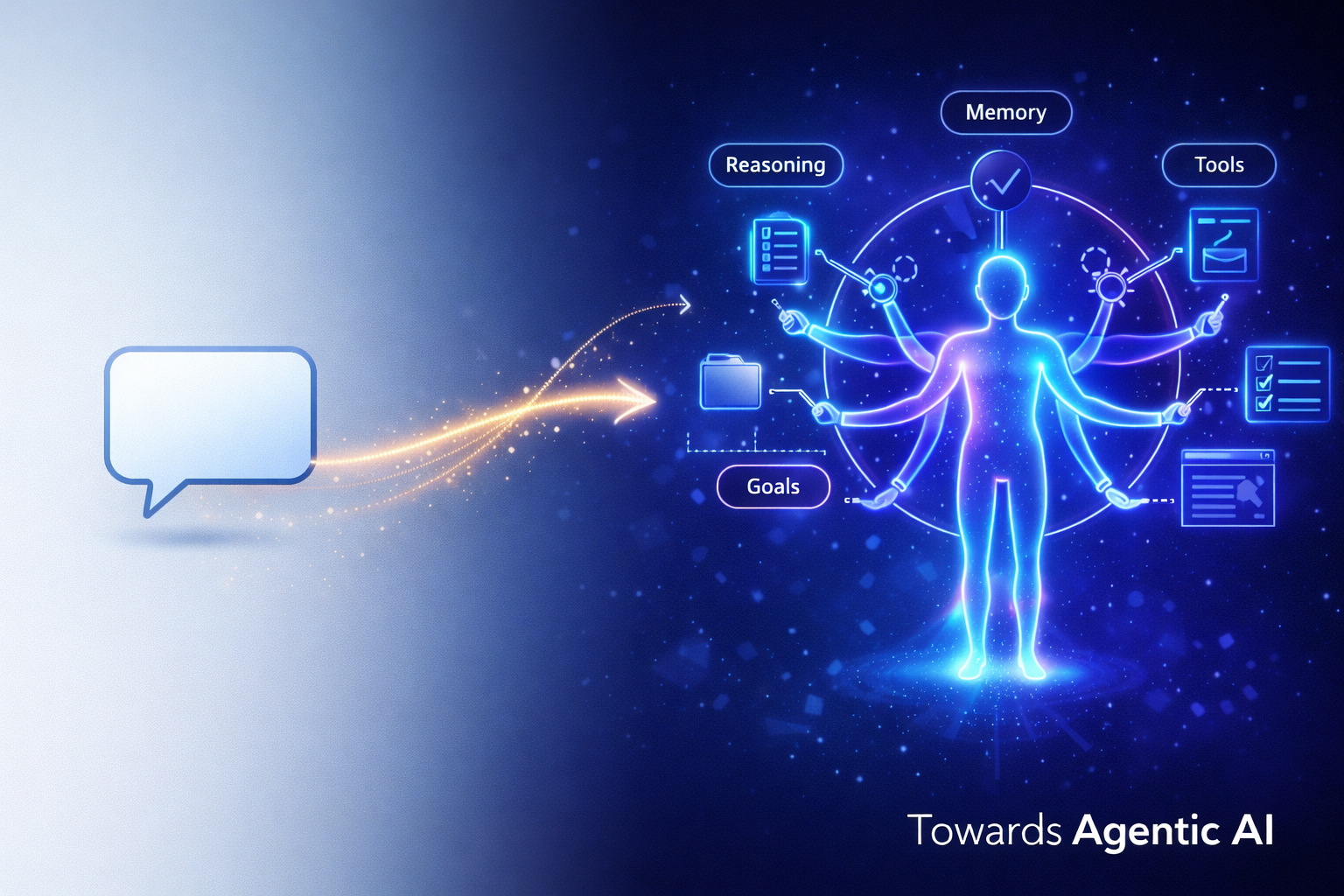
Traditional AI (Chatbots)
- Responds to a single prompt
- No memory between turns
- Cannot use external tools
- Waits for human instructions
- One-shot output
Agentic AI (Agents)
- Pursues multi-step goals autonomously
- Maintains context and memory
- Uses APIs, databases, and tools
- Decides its own next action
- Iterates until the goal is achieved
The Core Components of an AI Agent
Every agentic system shares four foundational components:
- Reasoning Engine — The LLM “brain” that decides what to do next based on context, goals, and observations.
- Memory Systems — Short-term (conversation context), long-term (knowledge base), and episodic (lessons from past actions) memory.
- Tool Interface — Connections to external APIs, databases, file systems, browsers, and other services the agent can invoke.
- Goal Management — The ability to decompose high-level objectives into sub-tasks, track progress, and adapt when plans fail.
Understanding these components is the first step on your agentic engineering journey.
Why Agentic Engineering Matters in 2026
The shift from experimental AI agents to production-grade agentic systems is already underway — and the data backs it up.
From Vibe Coding to Professional Discipline
The industry has moved beyond “vibe coding” — expressing intent and hoping AI generates something useful — toward something far more structured. Agentic engineering recognizes that professional software development requires planning, verification, iterative refinement, and governance to produce systems that are secure, scalable, and viable for real business use.
Engineers are shifting from writing code to coordinating agents that write code, focusing their expertise on architecture, system design, and strategic decisions. This is the same pattern we saw when DevOps transformed operations: the work didn’t disappear — it moved up the abstraction stack.
The Microservices Moment for AI
Just as monolithic applications gave way to distributed microservice architectures, single all-purpose agents are being replaced by orchestrated teams of specialized agents. One agent handles code generation, another runs quality checks, a third manages deployments, and an orchestrator coordinates them all. Building these multi-agent systems at production scale is what agentic engineering is all about.
Prerequisites: What You Need Before You Start
Before diving into agentic AI frameworks, you need a solid foundation. Here is what to learn — and in what order.
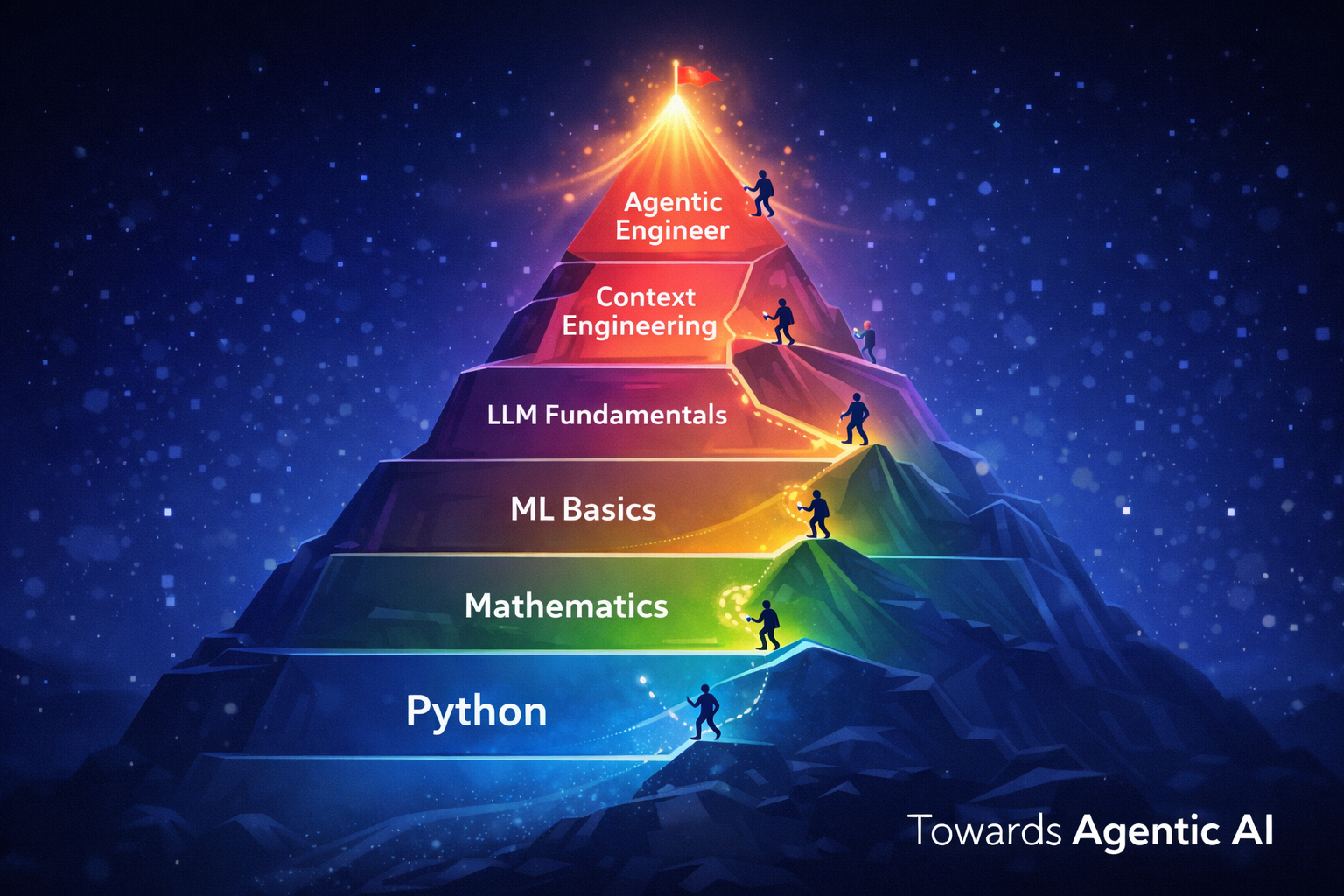
Python Programming (Essential)
Almost every AI framework, library, and tool is built for Python first. You need solid proficiency in Python fundamentals: data structures, functions, classes, error handling, and working with APIs. If you are new to Python, spend 4-6 weeks here before moving forward.
Mathematics Foundations (Important)
Linear algebra (vectors, matrices, embeddings), probability and statistics, and basic graph theory. You do not need a PhD — but you must understand vectors and embeddings since they power memory in vector databases, and graph theory is essential for agent orchestration workflows.
Machine Learning Basics (Recommended)
Understand supervised vs unsupervised learning, neural networks, transformers, and the attention mechanism. You do not need to train models from scratch — but knowing how LLMs work under the hood helps you debug agent behavior and optimize performance.
LLM Fundamentals (Critical)
How large language models work: tokenization, context windows, temperature, top-p sampling, and API usage. Practice calling OpenAI, Anthropic, or Google APIs directly. Understand token limits, pricing, and rate limiting — this is your daily toolkit.
Prompt & Context Engineering (Critical)
Advanced prompt engineering: Chain-of-Thought (CoT), ReAct (Reason + Act), few-shot prompting, and system prompts. In 2026, this has evolved into context engineering — designing the full information environment around an LLM, not just the user prompt.
You do not need an advanced degree in machine learning or AI. Strong coding skills, curiosity, and the ability to learn quickly are what matter most. Many successful agentic engineers come from traditional software engineering backgrounds.
The Complete Agentic Engineering Roadmap
Here is a structured, phase-by-phase learning path that takes you from beginner to production-ready agentic engineer. Each phase builds on the previous one.
Phase 1: Foundations (Weeks 1-4)
Goal: Understand how LLMs work and learn to interact with them programmatically.
What to learn:
- How transformer-based LLMs process text (tokenization, attention, generation)
- API fundamentals: calling Claude, GPT, or Gemini APIs with structured inputs
- Prompt engineering patterns: zero-shot, few-shot, Chain-of-Thought, ReAct
- Understanding context windows, token limits, and model capabilities
Resources:
- Anthropic’s Prompt Engineering Guide — Free, comprehensive
- DeepLearning.AI: ChatGPT Prompt Engineering for Developers — Free short course
- Andrew Ng’s Machine Learning Specialization on Coursera — For ML fundamentals
Milestone: You can write effective prompts that produce reliable, structured outputs from any major LLM API.
Phase 2: Agent Fundamentals (Weeks 5-8)
Goal: Understand agent architectures, design patterns, and core concepts.
What to learn:
- Agent architecture: perception → reasoning → action → observation loops
- Agentic design patterns: ReAct, Plan-and-Execute, Tool Use, Reflection, and Multi-Agent
- Memory systems: short-term (conversation), long-term (vector databases), episodic (experience)
- Tool calling: how agents connect to external APIs, databases, and services
- Retrieval-Augmented Generation (RAG): giving agents access to domain-specific knowledge
- Agentic RAG: agents that search, evaluate whether results are sufficient, and search again if needed
Resources:
- DeepLearning.AI: AI Agents in LangGraph — Free course by Harrison Chase
- LangChain Academy — Structured courses on agents and RAG
- Anthropic’s Agent Guide — Building agents with Claude
Milestone: You understand the major agent patterns and can explain when to use each one.
Phase 3: Framework Mastery (Weeks 9-14)
Goal: Build agents using the leading agentic AI frameworks.
This is where you go hands-on with the tools that production teams actually use. Focus on mastering two or three frameworks deeply rather than touching all of them superficially.
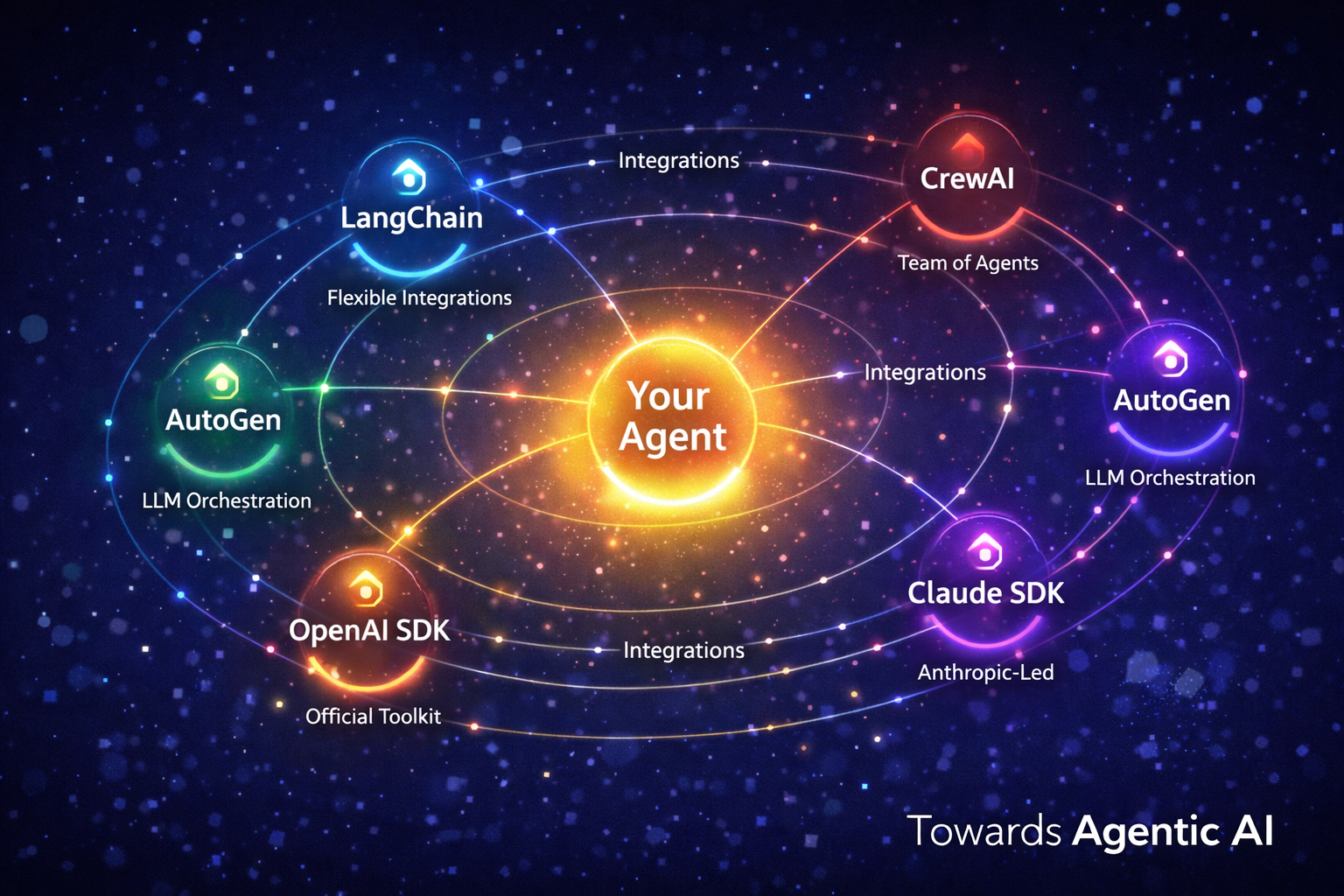 Frameworks
| Framework | Best For | Difficulty | 2026 Adoption |
|---|---|---|---|
| LangChain / LangGraph | Complex, stateful workflows | Intermediate | Very High |
| CrewAI | Role-based multi-agent teams | Beginner-Friendly | High |
| Microsoft AutoGen | Enterprise, human-in-the-loop | Intermediate | High |
| OpenAI Agents SDK | OpenAI ecosystem integration | Beginner-Friendly | Growing |
| Claude Agent SDK | Anthropic ecosystem, safety-first | Beginner-Friendly | Growing |
| Semantic Kernel | Microsoft/.NET enterprise AI | Intermediate | Growing |
Recommended learning order:
- Start with CrewAI — Easiest to learn, teaches multi-agent concepts naturally through role-based collaboration
- Move to LangChain/LangGraph — Industry standard, most comprehensive ecosystem, essential for production work
- Add AutoGen or OpenAI Agents SDK — Expands your enterprise and ecosystem capabilities
Resources:
- Coursera: Agentic AI with LangGraph, CrewAI, AutoGen and BeeAI — IBM course
- Udemy: The Complete Agentic AI Engineering Course — 6-week intensive covering all major frameworks
- CrewAI Official Documentation — Tutorials and guides
- LangGraph Documentation — Graph-based agent orchestration
Milestone: You can build a multi-agent system that decomposes a goal, delegates to specialized agents, and delivers a result.
Phase 4: Production Skills (Weeks 15-20)
Goal: Learn to deploy, monitor, and govern agents in real-world environments.
Building an agent that works in a notebook is one thing. Running it in production with real users, real data, and real consequences is another. This phase bridges that gap.
What to learn:
- Evaluation and testing — Agent evaluation is its own discipline now. Learn to benchmark agent performance with metrics beyond accuracy: task completion rate, cost per task, latency, and safety compliance
- LLMOps / AgentOps — CI/CD for prompts, staged rollouts, rollback strategies, and observability. Tools like LangSmith, Weights & Biases, and Arize are essential
- Bounded autonomy — Designing agents with clear operational limits, escalation paths to humans for high-stakes decisions, and comprehensive audit trails
- Security and governance — Most CISOs are deeply concerned about AI agent risks. Learn to implement guardrails, input validation, output filtering, and compliance frameworks
- Cost optimization — Choosing the right model for each sub-task, caching strategies, and managing token budgets at scale
Resources:
- LangSmith Documentation — Agent observability and evaluation
- Anthropic’s Safety Research — Understanding AI safety principles
- Weights & Biases: LLMOps Guide — Production monitoring for AI systems
Milestone: You can deploy an agent system to production with monitoring, evaluation, guardrails, and a rollback plan.
Phase 5: Specialization and Advanced Topics (Weeks 21+)
Goal: Develop deep expertise in a specific agentic engineering domain.
Agentic Coding
Build AI agents that write, review, test, and deploy software. Tools: Claude Code, Cursor, Windsurf, GitHub Copilot Agent.
Agentic Data Engineering
Self-orchestrating data pipelines, autonomous ETL, and data quality agents across Databricks, Snowflake, and cloud platforms.
Enterprise Agent Architecture
Designing multi-agent systems for large organizations: governance, compliance, security, and scalability patterns.
Agent Safety & Alignment
Ensuring agents behave as intended: red-teaming, constitutional AI, and formal verification of agent behaviors.
Advanced topics to explore:
- Model Context Protocol (MCP) — The emerging standard for connecting AI agents to external tools and data sources
- Multi-agent orchestration patterns — Hierarchical, peer-to-peer, blackboard, and marketplace architectures
- Agentic SDLC — How autonomous agents are reshaping the entire software development lifecycle
- Neuro-symbolic reasoning — Combining neural networks with symbolic logic for more reliable agent decision-making
Where to Learn: Top Courses and Certifications
Free Resources
| Resource | Provider | What You Get |
|---|---|---|
| Prompt Engineering Guide | Anthropic | Comprehensive prompt engineering for Claude |
| DeepLearning.AI Short Courses | Andrew Ng | Free courses on agents, RAG, LangChain, and more |
| LangChain Academy | LangChain | Structured courses on building with LangChain/LangGraph |
| Hugging Face NLP Course | Hugging Face | Transformers and NLP fundamentals |
Paid Courses
| Course | Platform | Duration | Cost |
|---|---|---|---|
| The Complete Agentic AI Engineering Course | Udemy | 6 weeks | ~$20-80 |
| Agentic AI with LangGraph, CrewAI, AutoGen and BeeAI | Coursera (IBM) | 4 weeks | Subscription |
| IBM RAG and Agentic AI Professional Certificate | Coursera | 3 months | Subscription |
| Agentic AI Bootcamp: LangGraph, CrewAI & MCP | Udemy | Self-paced | ~$20-80 |
University Programs
| Program | Institution | Level |
|---|---|---|
| Agentic AI Certificate Program | Johns Hopkins University | Professional Certificate |
| Agentic AI Certification Course | Edureka | Professional Training |
Professional Certifications
NVIDIA Agentic AI LLMs Professional Certification
The industry’s first dedicated agentic AI professional certification. Validates your ability to architect, develop, deploy, and govern advanced agentic AI solutions.
- Level: Intermediate
- Prerequisites: 1-2 years experience in AI/ML roles
- Format: Online, proctored — 60-70 questions in 120 minutes
- Link: nvidia.com/certification
Career Paths and Roles
Agentic engineering is creating entirely new job titles and transforming existing ones. Here are the roles emerging in 2026:
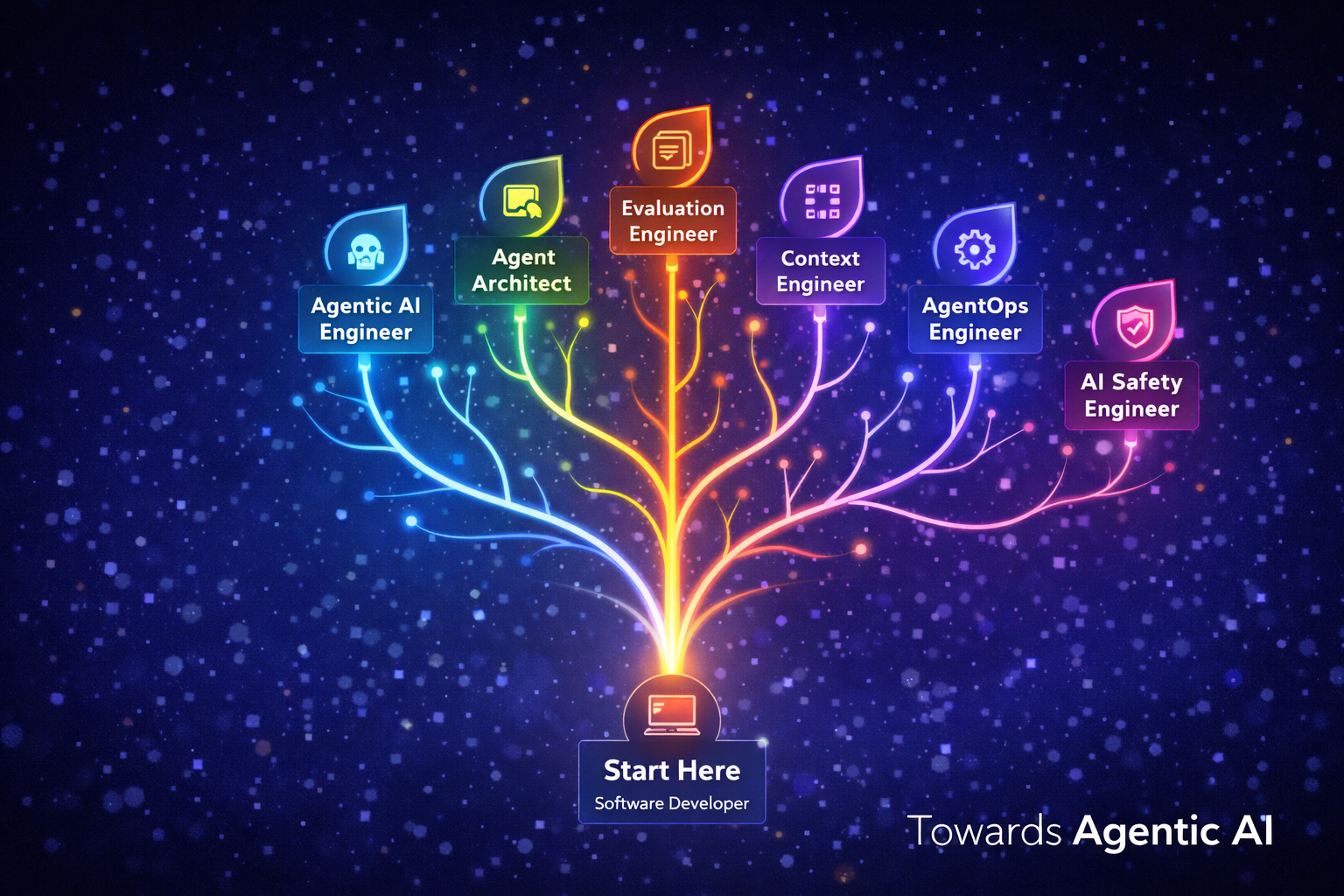
Agentic AI Engineer
Designs and builds multi-agent systems using frameworks like LangChain, CrewAI, and AutoGen. The most in-demand role in this space.
AI Agent Architect
Designs enterprise-scale agent architectures: orchestration patterns, security boundaries, and integration strategies.
Agent Evaluation Engineer
Specializes in testing and benchmarking agent systems. Builds evaluation pipelines, red-teams agent behavior, and ensures safety compliance.
Other emerging roles include:
- Context Engineer — Designs the information environment that agents operate in
- AgentOps Engineer — Manages deployment, monitoring, and observability for agent systems (the “DevOps of AI agents”)
- AI Safety Engineer — Implements guardrails, bounded autonomy, and compliance for autonomous systems
- Agentic Product Manager — Defines how agents should behave from a user-experience and business perspective
According to Index.dev, agentic AI skills are among the most sought-after in 2026. Companies are willing to pay premium salaries for engineers who can build, deploy, and govern production-grade agent systems.
How to Get Started Today
You do not need to wait until you have mastered every prerequisite to begin. Here is a practical action plan you can start this week:
This Week: Try an AI Coding Agent
Install Claude Code, Cursor, or GitHub Copilot. Use it for your daily work. Pay attention to how the agent reasons, uses tools, and handles multi-step tasks. This builds intuition before you study theory.
Week 2: Take a Free Course
Start with DeepLearning.AI’s free short courses or Anthropic’s prompt engineering guide. These give you foundational vocabulary and concepts in just a few hours.
Month 1: Build Your First Agent
Follow a CrewAI or LangGraph tutorial and build a simple multi-agent system. Start small: a research agent that gathers information and a writer agent that produces a report.
Month 2-3: Build a Portfolio Project
Create a real-world agent system that solves a genuine problem. Document your design decisions, evaluation results, and lessons learned. Share it on GitHub.
Month 4+: Pursue Certification
Once you have hands-on experience, pursue the NVIDIA Agentic AI Professional certification or a university certificate to validate your skills formally.
Conclusion
Agentic engineering is not a future trend — it is the present reality of software development in 2026. The transition from writing code line-by-line to orchestrating teams of autonomous AI agents is happening right now, and the professionals who master this discipline will lead the next era of technology.
The roadmap is clear: build your foundations in Python and LLMs, master the core frameworks, learn to deploy agents safely in production, and specialize in the domain that excites you most. The barriers to entry are lower than you might think — you do not need a PhD, and many of the best learning resources are free.
What you do need is the willingness to start building. Install a coding agent today. Take a free course this week. Build your first multi-agent system this month. The field of agentic engineering is being defined right now, and there is room for you to help shape it.
References:
- Anthropic: 2026 Agentic Coding Trends Report
- Glide: What is Agentic Engineering?
- The New Stack: 5 Key Trends Shaping Agentic Development in 2026
- LangChain: State of AI Agents
- ICSE 2026: International Workshop on Agentic Engineering
- CIO: 5 Ways Agentic Engineering Transforms Agile Practices
- Index.dev: Agentic AI Essential Skills and Roles for 2026
- MachineLearningMastery: The Roadmap for Mastering Agentic AI in 2026